Hotline Numbers
On Election Day
612-255-3112
Election issue triage center
Immigrant Defense Network in collaboration from many state-wide groups
will be in hosting a hotline number / response center. They
can connect you to assistance for voting rights, translation, information,
incident reporting & so much more. If you need to remember one number — this is it.
MN Secretary of State
(877)600-8683
Information available in multiple languages
Common Cause Election Protection
(866)OUR-VOTE
We will place thousands of volunteers on the ground, and recruit a team of legal experts to staff the 866-OUR-VOTE hotline.
- English: 1-866-OUR-VOTE / 866-687-8683
- Spanish: 1-888-VE-Y-VOTA / 1-888-839-8682
- Arabic: 1-844-YALLA-US / 1-844-925-5287
- Bengali, Cantonese, Hindi, Urdu, Korean, Mandarin, Tagalog, Vietnamese): 1-888-API-VOTE / 1-888-274-8683
Vote 411
(218)213-5009
League of Women Voters
Election Day Problems? Call or text -866-OUR-VOTE (866-687-8683) or 1-888-VE-Y-VOTA (en Español)
DFL Voter Protection Hotline
(833)355-8683
Call if election judge is not handling situations to satisfaction.
MN Safe at Home Program
(866)723-3035
MN Relay Service: 711
Minnesota’s address confidentiality program
Twin Ports Rapid Response
(218)213-5009
See or experience an ICE raid or related harassment of our neighbors
in the Duluth / Superior region?
Call us.
ACLU incident reporting form
Rights Violated by ICE or Federal Forces? Let us know!
Voting Resources
This will be evolving over time.
We welcome your suggestions!
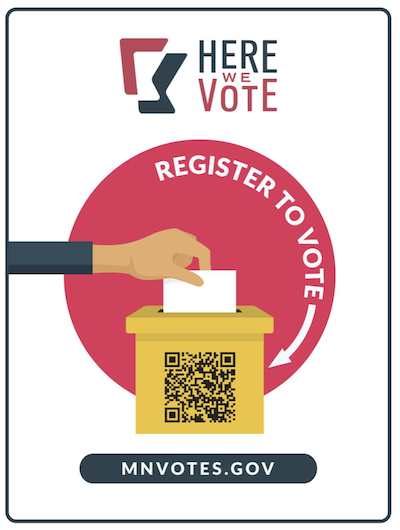
MNVotes.gov
Elections & Voting Info
A wealth of resources provided by the Office of the MN Secretary of State.
Am I Registered to Vote?
Be Ready to Vote!
Check your voter registration status with these easy online tools.
Who represents me?
An easy lookup tool
With an address search field and a handy map.
Get ready for election season
DFL Voter Resources & Training Hub
The DFL Training Hub is your home for skills, leadership development, and practical tools to organize, run strong campaigns, and build a winning movement in 2026 and beyond.
Whether you’re brand new to the DFL or an experienced organizer, our training pathways help you grow your skills step-by-step with live trainings, on-demand courses, and certifications designed for volunteers, party leaders, and candidates across Minnesota.
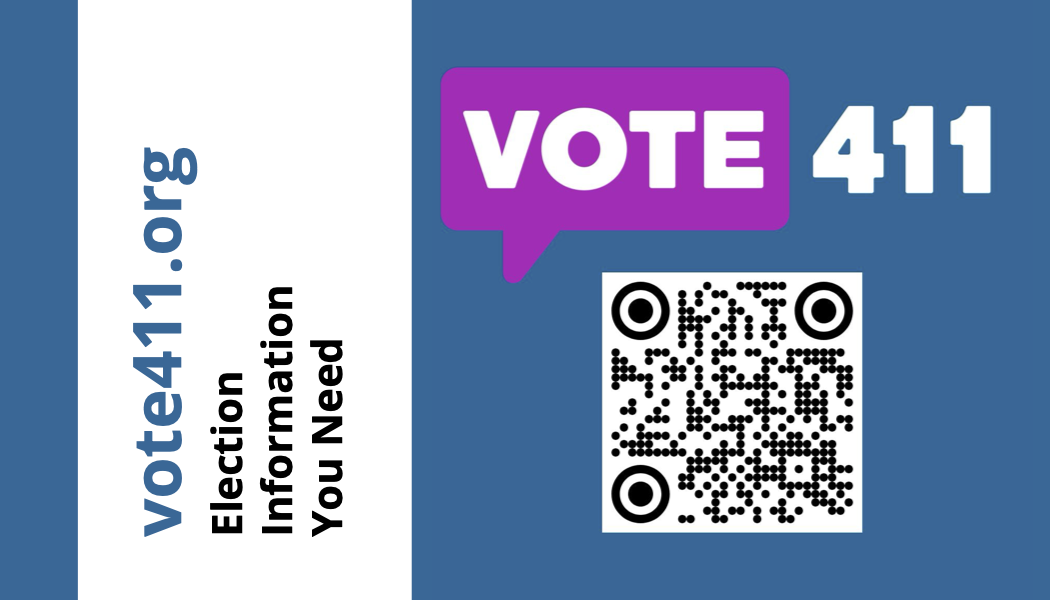
Vote 411
League of Women Voters
For more than 100 years, the League has fought to protect the rights of voters and expand access for those who’ve been left out of our democratic process. We do so through a combination of advocacy, litigation, education, partnerships, and grassroots efforts.
Election Day Problems? Call or text -866-OUR-VOTE (866-687-8683) or 1-888-VE-Y-VOTA (en Español)
Planning a Voter Registration Drive
The League of Women Voters
Interested in planning a nonpartisan voter registration drive?
The League of Women Voters has some expert tips
Be a Walking Voter Registration Booth
Talk to neighbors, friends, family, co-workers — Make sure everyone has a plan to vote.
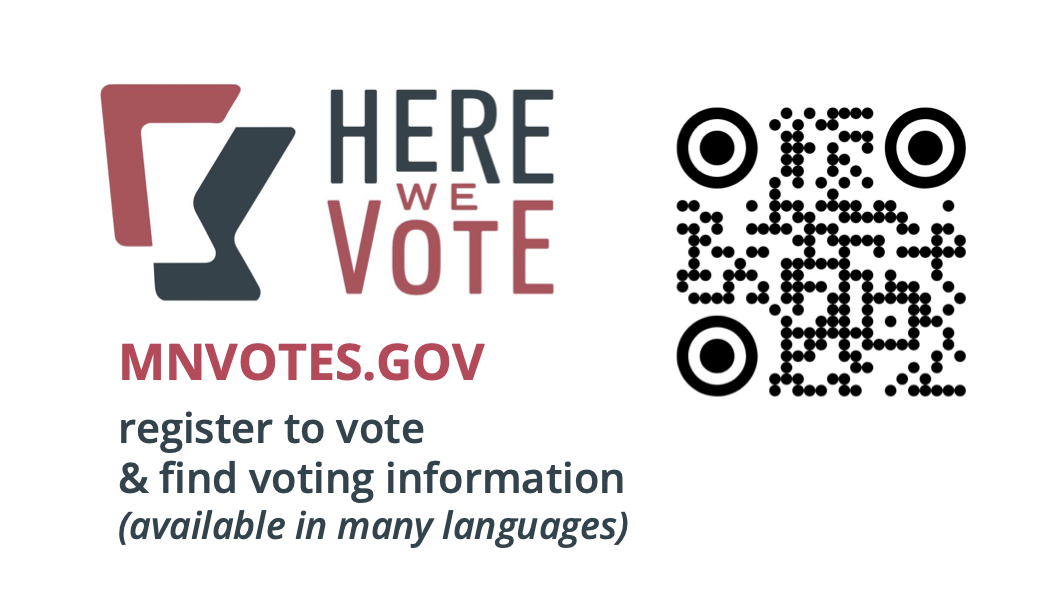
We have business-size cards you can print & distribute.
Download & print on your own, send a digital version to your contacts, or arrange for us to get you
already-printed cards.
Once you have a card in hand you can help people you encounter use a handy QR code to get straight
to an online voter registration portal.
We've got this!
Voting Rights
& Threats to Elections
Who Gets Voting Rights?
Civics Made Easy from PBS
In this episode of Civics Made Easy, Ben Sheehan uncovers the surprising – and often overlooked – true history of voting rights in America. From the founding era to Reconstruction to Civil Rights to today, this is the story that may not have been fully taught in school.
Organizing to Protect Democracy
How elections work (from the ACLU)
In a moment when our right to vote is facing relentless attacks, understanding how elections work has never been more important.
Now, we have the electoral knowledge and skills to be active in protecting our democracy.
Election Protection
from Common Cause
"We will place thousands of volunteers on the ground, and recruit a team of legal experts to staff the 866-OUR-VOTE hotline. Common Cause is a crucial line of defense for voters against suppression tactics, confusing laws, outdated infrastructure, and other impediments to making themselves heard. Above all, we inform voters of their rights, help elections officials handle problems in real time, and notify legal teams when the courts’ interference is needed.
"State-by-state, we place trained poll monitors at polling places, especially in communities with a history of voting problems, where hotly-contested races exacerbate the chance of long lines, confusion, and other complications. We’ll also be in states where there may be confusion about voter ID requirements. Poll monitors will provide information, troubleshoot problems, and report bad practices to our teams to resolve them with election officials."
Voting & Elections
from the Brennan Center for Justice
"Americans still face many barriers to voting. Meanwhile, elections require secure systems and independent administration of the casting and counting of ballots. The Brennan Center fights for voting rights, and we advocate for plans that will safeguard the election system — and the officials who work in it — from attacks and political interference."
The People’s Guide to Voting Rights
from Democracy Forward
"This guide covers the voting landscape of the 2026 midterm elections and informs voters about their rights and options
Democracy is not self-sustaining. It requires constant defense in courtrooms, in legislatures, in the streets, and at the ballot box."
Federal Agents at the Polls
from the ACLU
"Americans still face many barriers to voting. Meanwhile, elections require secure systems and independent administration of the casting and counting of ballots. The Brennan Center fights for voting rights, and we advocate for plans that will safeguard the election system — and the officials who work in it — from attacks and political interference."
Oppose the SAVE Act
Write to your Legislators
..."if anything like this ever did become law, the cleanest single document would likely be a valid U.S. passport in your current legal name, because it proves citizenship directly. A REAL ID driver’s license would not, by itself, count as proof of citizenship under this proposal. People with name changes could be forced to assemble a full paper trail connecting birth certificates, marriage licenses, divorce decrees, or court orders to their current legal identity."
Election Chiefs Decry SAVE America Act
from Democracy Docket
"The bill’s restrictions on the right to vote also aren’t hypothetical: Similar laws passed by states in the past led to widespread disenfranchisement, Simon said. He highlighted Kansas’ Secure and Fair Elections (SAFE) Act in 2011.
"Though noncitizen registration in the state was statistically nonexistent, Kansas adopted SAFE and mandated that prospective voters show documentary proof of citizenship to register. That requirement, which has since been blocked by federal courts, prevented over 31,000 eligible citizens from registering to vote.
"'This isn’t some theoretical or imagined circumstance,' Simon said.
'This bill assumes that every voter can navigate these requirements and navigate them quickly, and that is just not reality,' Connecticut Secretary of State Stephanie Thomas (D) said before raising specific examples of people who could be affected by the bill’s proof of citizenship requirements.
"'Imagine a woman, divorced, she’s moved, changed her name and needs to update her voter registration,' Thomas said. 'Under this bill, that is no longer a simple matter. It means tracking down multiple documents.'
'Or imagine an 82-year-old man, he just moved into assisted living. He’s voted his entire life. He’s never had a passport. No one knows where his birth certificate is at this point, and he doesn’t have a family member to help him use a computer,' she added. 'That lifelong voter could be blocked, not because he’s ineligible, but because he can’t produce the right document at the right time.'"
Stacey Abrams on Voter Supression
from NPR
"Stacey Abrams is one of the most high-profile voting rights activists in the U.S. She says whether we have an actual democracy might literally depend on protecting voting rights in the next election cycle or two. How to prevent that? Keep an eye on the 10 steps from democracy to autocracy."
Fact Check: Voting Fraud is Rare
from the AP
"The nation’s multilayered election processes provide many safeguards that keep voter fraud generally detectable and rare, according to current and former election administrators of both parties."
Documentary Proof of Citizenship (DPOC) Laws Action Kit
League of Women Voters
"DPOC laws require individuals to provide physical documentation--a passport, birth certificate, or naturalization papers--proving U.S. citizenship before registering to vote or requesting a ballot."
Resist efforts to pass these laws.
This resource explains why DPOC laws are harmful and how you can fight back.
What is Gerrymandering
An easy explainer on gerrymandering from Red Wine & Blue
"Once voters understand what gerrymandering is, they agree that it undermines our democracy. We all want our votes to count fairly and equally. Elections should be decided by voters, not by the politicians themselves before we even get to the polls!"
Delivering the Vote
How 4 pressures are testing the Postal Service’s role in American elections
"Every election cycle, tens of millions of Americans vote without setting foot in a polling place. Their local election office mails them a paper ballot, they mark it at home, and they hand it back to a letter carrier to return. Over the past three decades this has grown from a niche convenience into how almost a third of the country votes: the share of voters casting a ballot by mail rose from 7.8% in 1996 to 21% in 2016, surged to 43% in the pandemic election of 2020, and settled at 29% in 2024 (Figure 1). In that election, the U.S. Postal Service (USPS) carried roughly 99 million ballots to and from voters.
"That national average masks wide variation among the states: in Oregon and Washington, more than 95% of voters cast their ballots by mail, while in West Virginia and Tennessee fewer than 3% do.
"That scale turns a question most people never think about into an urgent one: what, exactly, is the Postal Service’s job in an election?"
Safe Elections
Protecting the right to vote
2026 Minnesota Election Judge Manual
This manual is a reference for election judges on Election Day
In particular, read the "Rules for Polling Place Conduct".
2025 Minnesota Statutes
Conduct in and near polling places
"An individual must be allowed to go to and from the polling place for the purpose of voting without unlawful interference. Except an election official or an individual who is waiting to register, to update the voter's registration, or to vote or an individual who is conducting exit polling, an individual must not stand within 100 feet of the building in which a polling place is located..."
Act Free to Be Free
A State and Local Pro-Democracy Framework A Civil Society Framework for Election Defense in 2026
"Anyone paying attention knows that Donald Trump is not preparing to lose the 2026midterms. He is preparing to disrupt and sabotage them, and his administration has beenlaying the groundwork for months.
"The harder problem is this: most of us (organizers, elected officials, legal advocates,pro-democracy funders) are still preparing for a normal election. We are running electionprograms. We are testing messages. We are mobilizing voters. These are not wrong thingsto do. They are profoundly insufficient for the threat we are actually facing.
"There is also something harder to name, a kind of collective avoidance. An unwillingness tofully believe our own eyes. Many Americans have internalized a story about ourselves thatsays we are immune from this kind of thing. We are not. And the next six months willmatter enormously for how far down the abyss we go."
Safe & Secure Elections
Minnesota 2026 Law Enforcement Quick Reference Guide
This pocket guide provides key parts of the state law pertaining to
election interference.
Hands Off Our Vote
from Indivisible
"In 2026 we are building our strongest election protection program ever, in all 50 states. We’re going to bring Indivisible’s grassroots organizing force out to ensure that whatever tricks they try to hold onto power, we’ll be ready."
Democracy on the Block Organizer Toolkit
from MN Voice
"DOB gatherings are celebratory community care events intended to promote voter participation and civic engagement at a precinct level. Gatherings are organized and hosted by teams of local volunteers, all of whom will receive Democracy Observer training through Minnesota Voice.
"Across the country, BIPOC, native, and immigrant voters are facing increased uncertainty around their right to vote in the 2026 election. One major concern is that immigration enforcement officers will expand their operations in communities and target polling sites to suppress voter turnout and encourage division among communities.
Democracy On The Block gatherings direct communities to combat dangerous narratives by reframing elections through the lens of community care. Through boots-on-the-ground organizing, connection to supportive live community calls, voter education, and community collaboration, Democracy On The Block reaffirms voting as a joyful expression of community power, and upholding our rights under the constitution."
Observer vs. Monitor
The biggest obstacle to the Trump DOJ’s election monitors? The right’s long attack on federal oversight
"Legally, two types of federal officials can oversee elections in some capacity: federal observers and federal monitors.
"Established by the Voting Rights Act, election observers are federal agents from the Office of Personnel Management who work with the DOJ’s Civil Rights Division to directly monitor elections.
"They can go inside polling places at all stages of the voting process, from polls opening through ballot counting, all while closely watching poll workers, voters and election machines.
"Federal election monitors, on the other hand, are Civil Rights Division attorneys deployed to ensure that states and localities are complying with federal voting and accessibility laws, such as the Help America Vote Act and the Americans with Disabilities Act.
"In general, the Civil Rights Division can deploy monitors to any jurisdiction, for any election — though, unlike observers, they are severely limited in their ability to oversee election processes.
"While monitors are meant to ensure compliance with federal law, they can only do so through limited observations. They have no law enforcement authority while monitoring. As such, it’s generally believed that they cannot enter polling places without a state’s consent, are subject to state election laws and have to openly identify themselves as monitors.
"Becker likened monitors to 'flies on the wall.'"
A Guide to Election Observer Policies in the United States
from the Carter Center
"Observers are trained to
attentively watch without interfering. They examine
not only Election Day activities, such as the casting
of ballots, but also pre-election and postelection
processes... Nonpartisan observation can provide a particularly
important way for citizens to encourage accountability
in the democratic system outside of party structures"